Our Thesis Statement
In light of unification efforts made by the late Sultan Qaboos in the 1970s, Zanzibaris are well integrated into the mainstream Omani identity in the public realm, and are thereby, in essence, only an ethnic minority as defined by White in the private sphere.
Interview with Ahmed explaining why Oman avoids using the word "minority" in formal documents.

A Comprehensive Review of the Zanzibari Minority in Oman
Purpose of the Project
Our project studies the different effects of the history between Zanzibar and Oman's impact on the Zanzibari population of Oman going forward.
This website is made to present our findings.
As a group, it was important for us to write about a minority group that was not as widely known and not previously discussed in class. Natalie, one of the group members suggested exploring one of the many minority groups in Oman. She was raised in Oman, and had insight to the diversity, history, and reality of Oman’s unique background and demographic make-up. There is not enough research and popularized academic work regarding Oman nor its history, thus broadening the general knowledge of the Middle East to include lesser-known countries such as Oman was very important.

UCLA History 111C Group 7
Meet
Our Team
Under the supervision of Dr. Momdjian, our group collaboratively researched the Zanzibari community in Oman. Here describes our work distrubution.
Xidong
Tang

Max is responsible for coordinating with professors and group members, collecting information from members, designing, creating, and establishing the website. He also has done the research and data visualizations and created the timeline for the history of Zanzibari in Oman.
Hayley
Birkland

Hailey focused on the history of Zanzibari women and their migration from Zanzibar to Oman during the 1964 revolution. She specifically addressed how this event impacted their identity, family, and sense of belonging. She also uncovered how Zanzibari women adapted through this move and settled in Oman.
Natalie Baltimore

Natalie conducted interviews on the following portions: Covering the Basics of Oman, comparing Swahilis to African slaves, comparing Swahilis to Baluchis, and the Indicators of Acceptance/Integration. She also added the disclaimer about the terminology that will be used in describing the group.
Megan Early Hamori

Megan's research focused on establishing a historical background of the Zanzibari people. This concentrated on elucidating the convoluted relationship between colonialism, expatriation, and eventually exile that is instrumental to understanding the group's identity.
Leslie
Landis
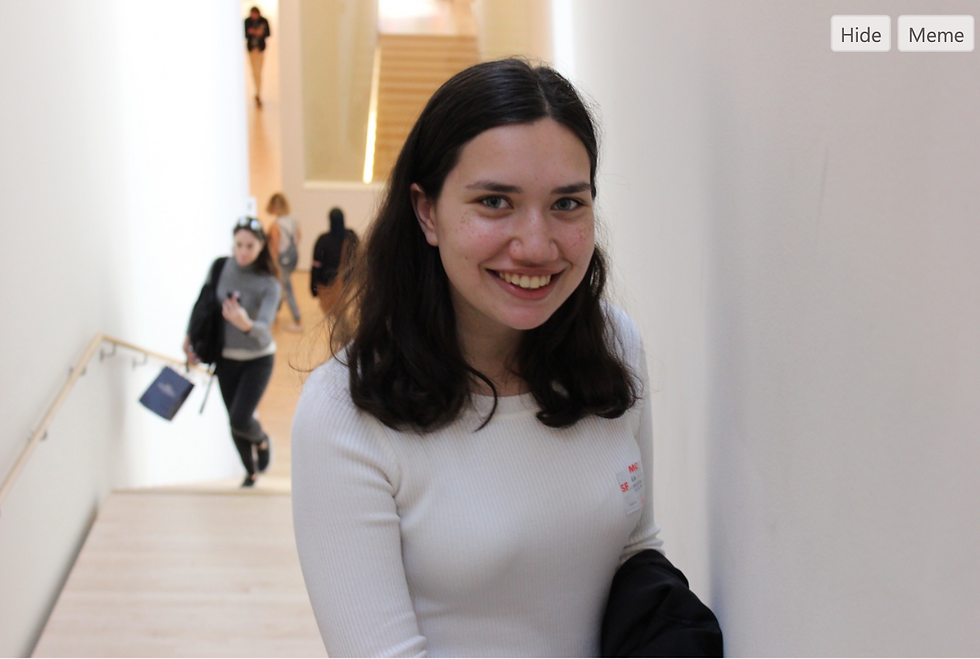
Leslie worked on Benjamin Thomas White’s interpretation of the term “minority” and whether that term accurately defines Zanzibaris in Oman. To do this, Lesilie studied chapter one of White’s The Emergence of Minorities in the Middle East as well as analyzed the modern history of East African - Omani relations.
Isabelle
Smith

Isabelle researched the ways that Omani and Zanzibari cultures intersect through the arts. She focused on a visual artist, a film director, and the practice of making chests.